aggregate citations reported
181-day overview export
Research report 003 / Version 1.0
What 35,310 reported AI citations reveal about time, volume, concentration, relative presence, and the pages supplying the evidence.
The original exports and complete analysis are available without a form or email gate.
The record at a glance
The daily overview, page export, and grounding-query export are separate reporting views. They are analyzed independently and never combined into one denominator.
181-day overview export
Page-level export
Query-export concentration
Page-export concentration
/fragrance, /clone, /clone-of
Observed pattern
Concentrated information needs. Distributed structured evidence.Four views of the result
Time, citation volume, relative presence, query concentration, and page participation described different parts of Scentonym's visibility.
AI search visibility is often reduced to citation totals, share-of-voice scores, or screenshots of favorable answers. Those measurements can be useful, but they do not describe the same outcome. A citation total says how often a source was displayed. It does not show how broadly that activity was distributed, where it was concentrated, how much relative citation presence the source held, or whether the associated brand was recommended.
This report examines six months of first-party Bing Webmaster Tools AI Performance data from Scentonym, an independent fragrance-information website that was approximately eight months old at the end of the observation period.
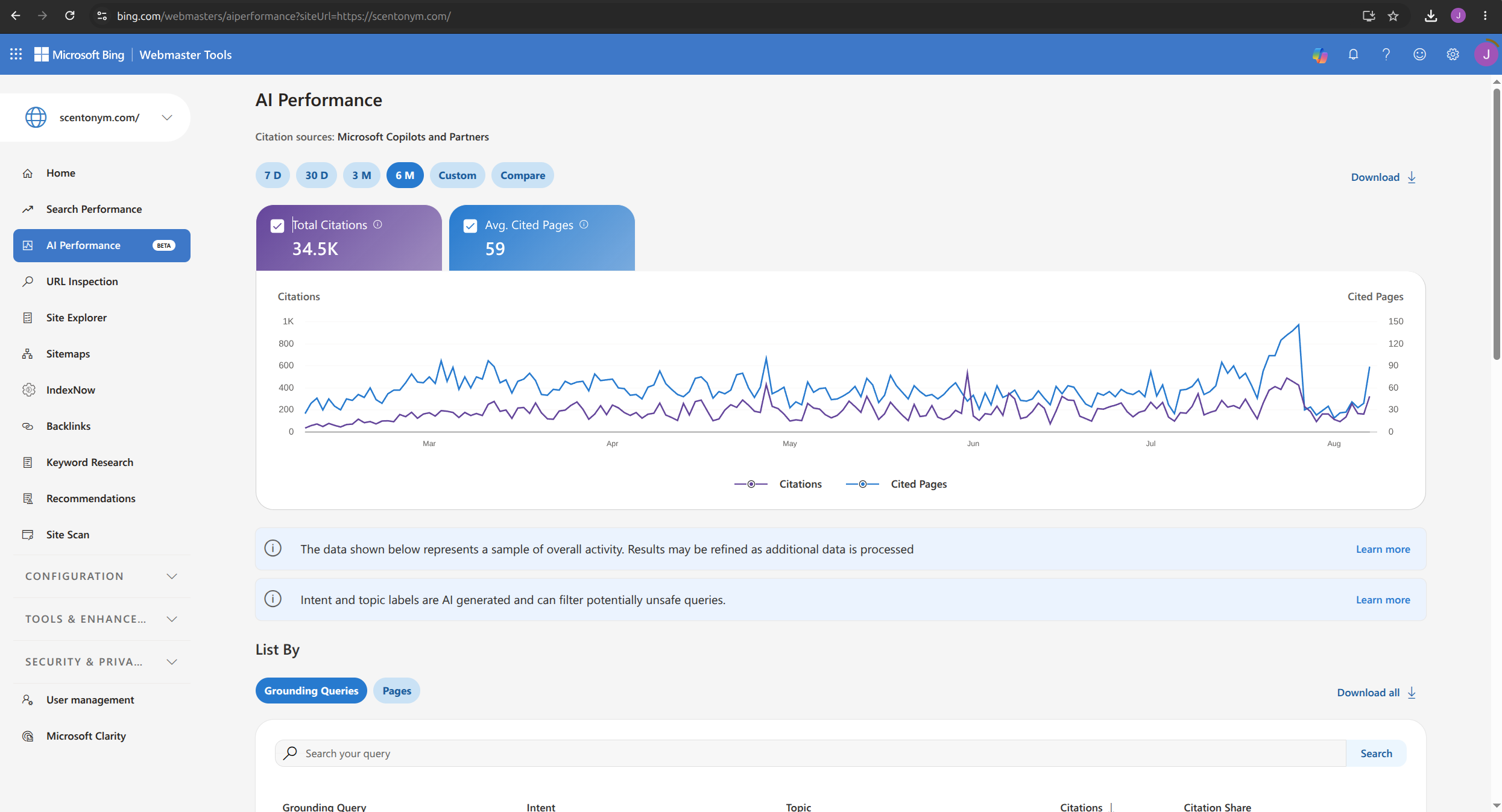
The complete daily overview export contains 181 consecutive dates from February 11 through August 10, 2026, with no missing days. It reports 35,310 citations, a daily mean of 195.1 citations, and a mean of 59.75 cited pages per day. An earlier dashboard capture recorded August 9 displayed a rounded 34.5K citations and 59 average cited pages. Microsoft notes that reported results may be refined as additional data are processed, so the later export supplies the exact aggregate used in this report while the screenshot preserves the earlier interface state.
Two additional exports provide narrower analytical views. The page export contains 1,354 cited URLs accounting for 22,745 sampled page-level citations. The grounding-query export contains 72 grouped query representations accounting for 1,901 sampled query-level citations, together with Microsoft-generated intent, topic, and Citation Share classifications.
The data reveal temporal variation and two different distribution patterns.
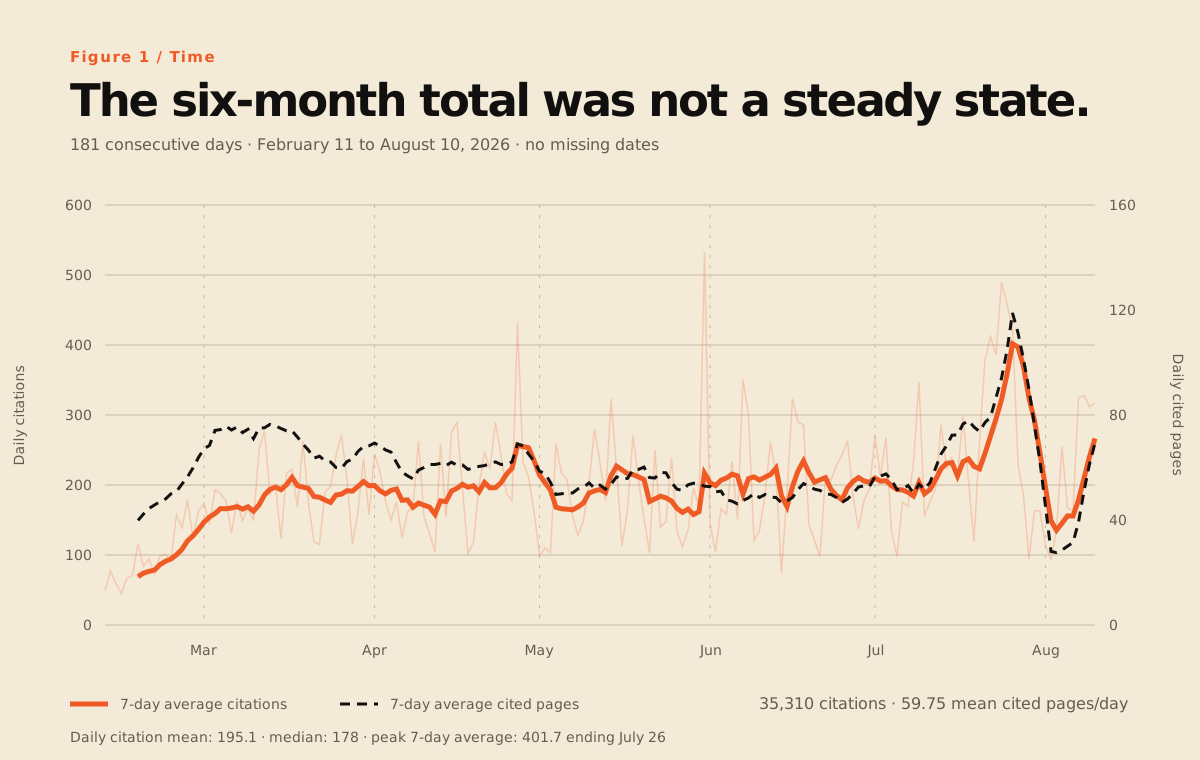
Daily citation activity was not steady. The seven-day average began at 69.1 citations per day, reached 401.7 for the period ending July 26, and ended at 266.4. The final 30 days averaged 254.5 daily citations, compared with 132.2 during the first 30 days. This describes variation within one observed window, not permanent growth.
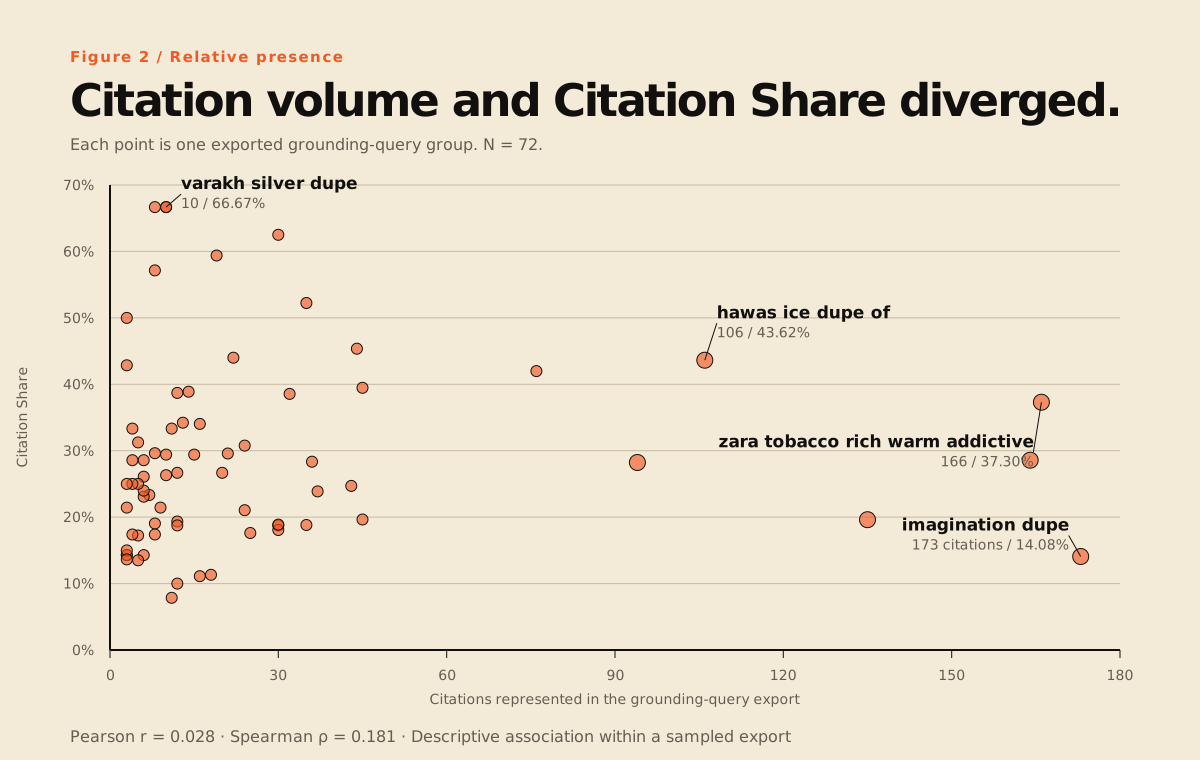
Query-level activity was concentrated. The ten highest-volume grounding-query groups accounted for 55.1% of citations represented in the query export. Commercial and Comparison classifications together represented 72.9% of that sampled activity. Citation count and Citation Share were only weakly aligned, with a Pearson correlation of approximately 0.028 and a Spearman rank correlation of approximately 0.181.
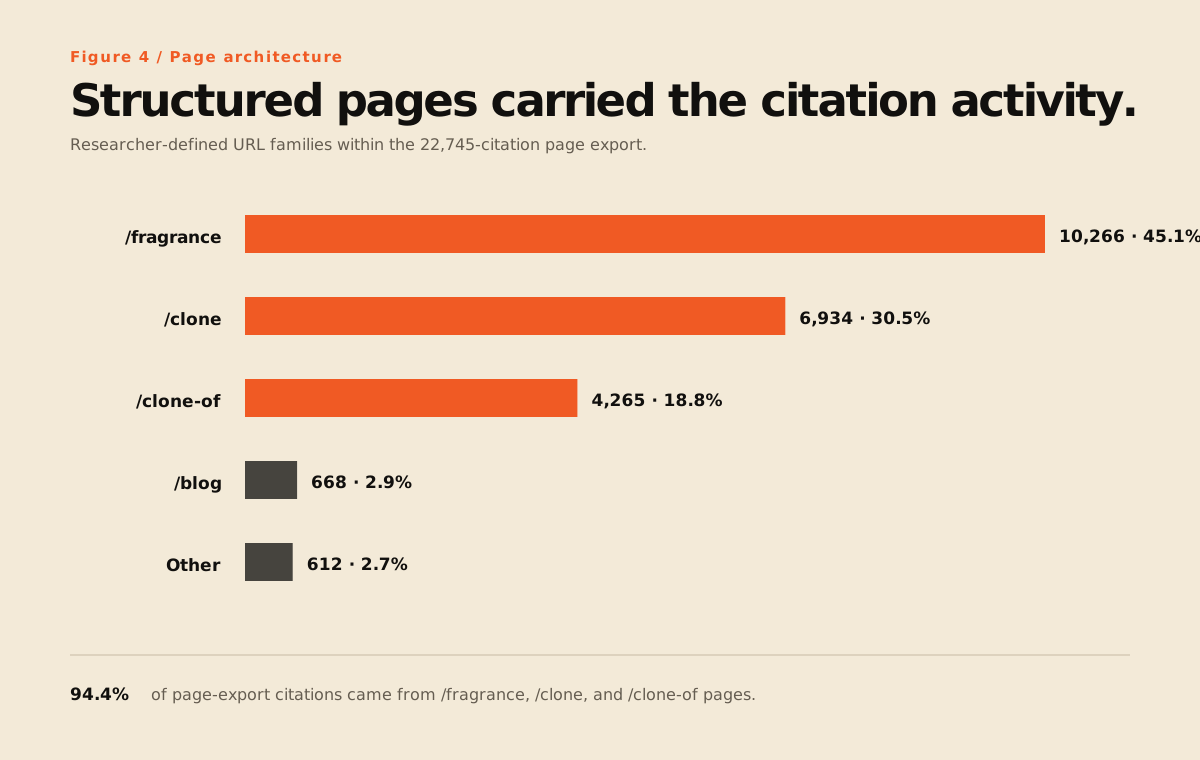
Page-level activity was considerably broader. The ten most-cited URLs accounted for only 14.7% of citations represented in the page export, while the top 100 accounted for 47.9%. Citation activity overwhelmingly involved structured fragrance and relationship pages: URLs under /fragrance, /clone, and /clone-of accounted for 94.4% of page-export citations. Blog pages accounted for 2.9%.
The central observation is therefore not simply that Scentonym received a large number of citations. It is that the activity changed substantially over time while a concentrated set of recurring information needs drew from a broad base of structured pages.
This report does not establish that page structure caused citation activity. It does not prove recommendation, traffic, sales, or equivalent visibility in another AI system. Its contribution is narrower: an original, reproducible case showing why citation visibility should be measured as a profile rather than collapsed into one number.
This report makes six contributions.
The report extends the argument developed in Measuring AEO, which separates technical eligibility, retrieval, citation, information use, brand presence, recommendation, preference, and business outcome.1
The central claim is straightforward:
A large citation number establishes source use. It does not describe the complete shape or consequence of that visibility.
Traditional search reporting commonly revolves around rankings, impressions, clicks, and conversions. Generative systems can retrieve information from multiple pages and synthesize those sources into an answer.
The foundational GEO research presented at KDD 2024 treated visibility within generated answers as an optimization problem distinct from conventional ranking.2 More recent work has separated citation selection from citation absorption, recognizing that a system can cite a page without relying heavily on it for the final answer.3 A 2026 critical survey describes generative visibility as a multistage, partially observable process rather than one ranking event.4
Microsoft's AI Performance reporting makes a related distinction in practice. The public preview introduced total citations, cited pages, grounding queries, page-level activity, and trends.5 The expanded report also includes intent classifications, topics, Citation Share, and comparisons over time. Microsoft explicitly states that the data are aggregated and sampled, that totals can differ between views, and that citation reporting does not measure rankings, authority, traffic, or page importance.6
Citation count answers one legitimate question:
How often was content from this property displayed as a source?
It does not answer several others:
This study examines what becomes visible when the headline number is separated into its underlying reporting views.
The subject property is Scentonym, an independently operated fragrance-information website.
Scentonym organizes information about fragrances, comparable products, clone relationships, brands, notes, performance, and value. At the end of the observed six-month period, the website was approximately eight months old.
The property was selected because it generated enough first-party citation activity to support descriptive analysis and because its operator had access to the underlying Bing Webmaster Tools reports.
The author of this report also operates Scentonym. That is a direct conflict of interest.
The conflict is disclosed rather than minimized. The original dashboard capture, source exports, analysis materials, and checksums are included so the descriptive results can be inspected without relying entirely on the author's interpretation.
This is an observed case. It is not a controlled test of a service or optimization technique. No untreated control property, randomized intervention, or counterfactual design is available.
The study uses three related artifacts from Bing Webmaster Tools.
| Reporting view | Observed value | Correct interpretation |
|---|---|---|
| Daily overview export | 35,310 citations across 181 days | Aggregate daily citation activity from February 11 through August 10 |
| Page export | 22,745 citations across 1,354 URLs | Sampled page-level activity represented in the export |
| Grounding-query export | 1,901 citations across 72 groups | Sampled query-level activity represented in the export |
These totals are not treated as parts of one reconciled dataset.
Microsoft states that AI Performance data are aggregated and summarized, that the information shown is not a complete log, and that totals may differ between page, grounding-query, and time-series views. Microsoft also notes that different views and filters can use samples from slightly different portions of the selected period.6
Accordingly:
The three views answer different descriptive questions.
The daily overview export contains 181 consecutive dates from February 11 through August 10, 2026. It has no missing dates and no duplicate rows.
| Daily overview measure | Observed value |
|---|---|
| Total Citations | 35,310 |
| Daily citation mean | 195.1 |
| Daily citation median | 178 |
| Mean Cited Pages | 59.75 per day |
| Selected reporting view | 6 months |
The earlier six-month dashboard capture, recorded August 9, 2026, reported:
| Dashboard measure | Observed value |
|---|---|
| Total Citations | 34.5K |
| Average Cited Pages | 59 |
| Selected reporting view | 6 months |
Microsoft defines Total Citations as the number of times content was visibly referenced or shown as a source in supported AI-generated answers during the selected range. Average Cited Pages is the average number of unique pages cited per day.6
The dashboard screenshot and later overview export are dated source records, not interchangeable measurements. The screenshot documents an earlier rounded interface total. The export extends through August 10 and provides the exact daily values used for aggregate and temporal analysis. Microsoft states in the interface that results may be refined as additional data are processed.
The page export contains two fields:
It includes 1,354 unique URL rows and 22,745 represented citations.
This view is used to measure page participation, page-level concentration, and citation distribution across researcher-defined URL families.
The grounding-query export contains five fields:
It includes 72 grouped query rows and 1,901 represented citations.
Microsoft describes grounding queries as grouped phrases associated with retrieval activity. They are not complete user prompts and should not be interpreted as direct estimates of consumer search volume.6
Citation Share is the percentage of citations attributed to the measured site out of all citations shown for the same grounding-query group. It measures relative citation presence, not rank, traffic, quality, or recommendation.
All three source CSV files were preserved without alteration.
For the daily overview analysis:
For the grounding-query analysis:
For the page analysis:
The path-family classification is researcher-defined:
/fragrance pages are treated as fragrance entity pages;/clone pages are treated as pages identifying alternatives to a fragrance;/clone-of pages are treated as pages organizing products associated with a target fragrance;/blog pages are treated as conventional editorial content.The combined /fragrance, /clone, and /clone-of category is referred to as structured entity and relationship pages. That label describes the site's URL and content architecture. It is not a Microsoft classification.
All calculations are descriptive. The export's sampling process is not sufficiently documented to support population-level inference from the rows.
The complete overview export contains 35,310 citations across 181 consecutive days. Daily citations averaged 195.1, with a median of 178 and a standard deviation of 84.4.
The lowest daily count was 45 on February 14. The highest was 533 on May 31.
The seven-day rolling average changed substantially:
| Seven-day period ending | Average daily citations |
|---|---|
| February 17 | 69.1 |
| July 26 | 401.7 |
| August 10 | 266.4 |
The first 30 days averaged 132.2 citations per day. The final 30 days averaged 254.5, an increase of 92.5% within the observed window. Average daily cited pages increased from 61.23 in the first 30 days to 71.03 in the final 30 days.
Daily citation count and cited-page count were positively associated, with a descriptive Pearson correlation of 0.685. That does not mean one caused the other. Both measures can rise when more of the property is being used across supported answers.
The time series also shows sharp changes. The seven-day citation average fell from its July peak before rising again at the end of the export. A six-month total therefore does not describe a steady level of daily activity.
The aggregate establishes scale. The daily export shows that the scale was produced by a changing process.
For an approximately eight-month-old property, the 35,310-citation record establishes a narrow but important fact:
Scentonym's content was repeatedly displayed as source material across supported Microsoft AI experiences within its first year.
It does not establish why the property was selected. It does not show that young sites generally receive comparable visibility.
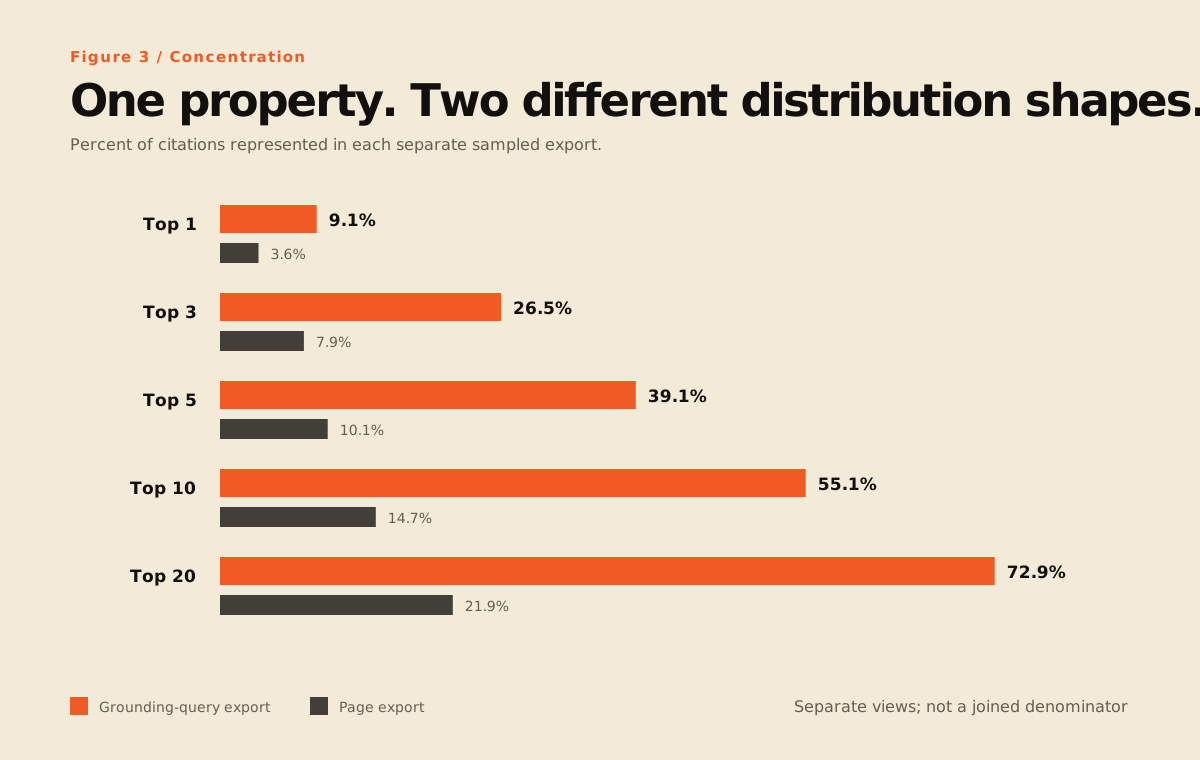
The 72 grounding-query groups represented 1,901 citations.
| Highest-volume query groups | Citations | Share of query-export citations |
|---|---|---|
| Top 1 | 173 | 9.1% |
| Top 3 | 503 | 26.5% |
| Top 5 | 744 | 39.1% |
| Top 10 | 1,048 | 55.1% |
| Top 20 | 1,386 | 72.9% |
More than half of the represented query-level activity came from ten of the 72 groups.
An aggregate citation total can therefore grow while depending heavily on a relatively small set of recurring information needs.
Microsoft's Intent field classified the represented citations as follows:
| Microsoft Intent classification | Citations | Share |
|---|---|---|
| Commercial | 1,188 | 62.5% |
| Informational | 250 | 13.2% |
| Comparison | 198 | 10.4% |
| Research | 142 | 7.5% |
| Other or unclassified | 123 | 6.5% |
| Total | 1,901 | 100% |
Commercial and Comparison classifications together represented 72.9% of the query-export citations.
That result shows that the sampled citation activity was not confined to general informational contexts. It does not show that a purchase occurred. Microsoft's intent labels are machine-generated classifications and can be imperfect, particularly in specialized categories.6
Across the 72 query groups:
The descriptive association between citation count and Citation Share was weak:
Citation Count and Citation Share
Pearson r = 0.028 | Spearman ρ = 0.181
Several source rows make the distinction clear:
| Grounding-query group | Citations | Citation Share |
|---|---|---|
| imagination dupe | 173 | 14.08% |
| zara tobacco rich warm addictive | 166 | 37.30% |
| hawas ice dupe of | 106 | 43.62% |
| varakh silver dupe | 10 | 66.67% |
| Hawas Ice clone | 10 | 66.67% |
The highest-volume group produced 173 citations but held only 14.08% Citation Share. Two ten-citation groups each reached 66.67%.
Eight groups had Citation Share of at least 50%. Together, they represented only 123 citations, or 6.5% of query-export activity.
Citation Count measures absolute source-use activity. Citation Share measures relative source presence for one grounding-query group. Neither substitutes for the other.
The page export shows a different distribution from the query export.
| Highest-volume pages | Citations | Share of page-export citations |
|---|---|---|
| Top 1 | 825 | 3.6% |
| Top 3 | 1,797 | 7.9% |
| Top 5 | 2,306 | 10.1% |
| Top 10 | 3,336 | 14.7% |
| Top 20 | 4,983 | 21.9% |
| Top 50 | 7,883 | 34.7% |
| Top 100 | 10,902 | 47.9% |
The median cited page received 6 citations in the export. The most-cited page received 825, or 3.6% of represented page-level activity.
The top ten grounding-query groups held more than half of query-export citations. The top ten pages held less than one-sixth of page-export citations.
These percentages should not be compared as if the exports were matched samples. They do, however, describe a clear difference in the shape of each reporting view: query activity was concentrated, while page participation extended across a large collection of URLs.
Citation activity by URL family was:
| URL family | Cited pages | Citations | Share of page-export citations |
|---|---|---|---|
/fragrance |
692 | 10,266 | 45.1% |
/clone |
420 | 6,934 | 30.5% |
/clone-of |
154 | 4,265 | 18.8% |
/blog |
53 | 668 | 2.9% |
/brand |
27 | 385 | 1.7% |
| Homepage | 1 | 193 | 0.8% |
| Other paths | 7 | 34 | 0.1% |
Combined, /fragrance, /clone, and /clone-of contained:
This is one of the study's strongest observations.
Scentonym's citation activity was not primarily concentrated in conventional articles about broad topics. It was distributed across pages that describe specific fragrance entities and explicit relationships among products.
The result does not establish that the URL structure or page format caused the citations. It establishes where the citation activity appeared.
Closely related product concepts appeared across multiple grounding-query strings.
Seven Hawas Ice-related groups represented 274 citations. Six Imagination-related groups represented 207.
| Illustrative concept family | Query groups | Represented citations |
|---|---|---|
| Hawas Ice | 7 | 274 |
| Imagination | 6 | 207 |
| God of Fire | 3 | 153 |
| Afnan 9PM | 5 | 86 |
| Rayhaan Obsidian | 3 | 58 |
| Khamrah | 3 | 45 |
These are researcher-created groupings based on repeated entity phrases. They are not Microsoft topic clusters.
The observation reinforces an important warning:
A grounding-query phrase is a retrieval representation, not an independent measure of human demand.
Taken together, the two exports reveal the study's most useful pattern.
At the query level, a relatively small collection of recurring information needs accounted for much of the represented activity.
At the page level, citations were spread across hundreds of specific fragrance and relationship pages. No single page dominated the export. Even the top 100 URLs accounted for less than half of represented page-level citations.
The pattern can be described as:
Observed citation pattern
Concentrated information needs + distributed structured evidence
This is not a causal model. The exports cannot show that one query group retrieved every page within a related family, and their sampled totals should not be joined directly.
It is a descriptive account of the property visible through two different first-party reporting surfaces.
The distinction matters for strategy. A site can depend on a relatively narrow group of recurring questions without depending on only a handful of pages. Conversely, a large content library does not necessarily imply diversified demand.
Both dimensions should be measured.
This case supports reporting citation visibility through six separate dimensions.
How often was content from the property displayed as a source?
How many pages, entities, or subject areas participated?
How much activity depended on the highest-volume pages or grounding-query groups?
How much of the citation space did the property occupy within each reported grounding-query group?
In what types of platform-classified contexts did the citation activity occur?
Did the pattern continue, grow, decline, or shift across repeated observation periods?
This dimension requires repeated measurement. One recorded period cannot establish that visibility is durable, particularly when generated answers and source selection can vary over time.7
These dimensions form a Citation Visibility Profile.
| Dimension | Scentonym observation in this study |
|---|---|
| Volume | 35,310 citations represented in the 181-day overview export |
| Breadth | 1,354 URLs represented in the page export |
| Concentration | Top 10 query groups held 55.1%; top 10 pages held 14.7% within their respective exports |
| Relative share | Median query-level Citation Share of 26.2% |
| Intent | 72.9% of query-export citations classified as Commercial or Comparison |
| Persistence | 181 consecutive daily observations; 7-day average ranged from 69.1 to 401.7 citations per day |
No universal composite score is necessary. Collapsing the profile into one number would discard the distinctions the data reveal.
The dashboard and exports establish that Scentonym's pages were repeatedly used as visible sources across supported Microsoft AI experiences.
They do not establish:
Research distinguishing citation selection from citation absorption is especially relevant here. A system can cite a page while using little of its language, evidence, or factual content in the generated response.3
The 35,310 figure therefore belongs in the citation layer of AEO measurement. It should not be promoted into a claim about recommendation or business impact.
Citation volume provides scale. It does not provide breadth, concentration, intent, or relative context.
The daily export showed a large difference between the beginning, July peak, and end of the observed period. A dashboard total cannot show whether citation activity is stable, rising, falling, or volatile.
The two views can produce different distribution patterns. A site may have concentrated query activity and broad page participation at the same time.
Citation Count and Citation Share behaved differently in this dataset. Reporting only one would conceal part of the result.
Intent and Topic add context, but they remain machine-generated labels. They should not be treated as verified descriptions of individual people.
The page export shows that structured entity and relationship pages accounted for most represented citations. That is a useful architectural observation. It is not proof that copying Scentonym's page structure will reproduce its performance.
Microsoft describes grounding systems as selecting supportable information for generated answers rather than simply presenting a ranked page.8 Controlled research also suggests that topical relevance and context position can influence citation selection, but those experiments do not establish that any one website architecture will cause durable organic visibility.9
A source can help an AI system answer a question without the associated brand or business becoming the recommended choice.
This report has substantial limitations.
The observations come from one fragrance-information website. They should not be assumed to generalize to another property, industry, or level of brand recognition.
The source data come from Bing Webmaster Tools and supported Microsoft AI experiences. They do not measure other AI products as equivalent systems.
Microsoft states that AI Performance is a representative, aggregated view rather than a complete event log. Dashboard, daily overview, page, and grounding-query totals can differ. The interface also states that results may be refined as additional data are processed.
The August 9 screenshot displayed a rounded 34.5K citations. The later overview export contains 35,310 daily citations through August 10. The report preserves both artifacts and uses the later complete export for exact aggregate calculations. Neither artifact should be treated as an immutable event log.
The exports do not disclose enough about row inclusion, sampling, suppression, or grouping to support population-level statistical inference.
The two source exports used here do not provide a complete row-level mapping between every grounding query and every cited page. Their distributions are analyzed separately.
Intent and Topic are produced by evolving Microsoft classifiers. Some labels in this dataset appear broad or counterintuitive for a fragrance-specific property.
The data do not include complete generated answers. Citation absorption, brand presence, recommendation, preference, and factual influence cannot be determined from these exports.
Grounding-query activity cannot be interpreted as query volume or a count of people asking a question.
The study cannot isolate why Scentonym was cited. It cannot establish that structured pages, internal architecture, website age, content depth, SEO, or another factor caused the observed result.
The author operates both the subject property and the organization publishing the report.
The Version 1.0 publication package contains:
Original daily AI Performance overview CSV
The unmodified 181-row export used for aggregate and temporal analysis.
SHA-256:
4597ce5cc018ca3273d1b96124b02899c1de28ce2f2203ccba80685387d394d1
Original Bing Webmaster Tools dashboard capture
The six-month AI Performance view reporting approximately 34.5K Total Citations and 59 Average Cited Pages.
SHA-256:
1d9d1fb1d84c62bfd3f455b0830f4975a064e1f989df4614c8fdc1c5a8b83963
Original grounding-query CSV
The unmodified 72-row source export used for query-level analysis.
SHA-256:
fc78c7cfd86711f3c0a0ac3fa4a5bae4ec2b92ce5642af0d78731835ffeb200f
Original page-level CSV
The unmodified 1,354-row source export used for page-level analysis.
SHA-256:
7a0400b9d192cb791d8f94a34d420625c5d84fbfcb1d33937203822b67e7c1fa
Reproducibility script and derived tables
The analysis materials reproduce:
Original source files remain separate from all derived materials.
This case creates several testable questions.
A multi-property, repeated-window study would be necessary before making broad claims about content architecture, website age, or citation acquisition.
The obvious result in this case is that the daily Bing Webmaster Tools overview export reported 35,310 citations for Scentonym across 181 consecutive days.
The more useful result is what appears underneath that number.
The property therefore showed a combination of concentrated information needs and distributed structured evidence.
That pattern would disappear inside one visibility score.
AEO requires more than counting visibility. It requires identifying the kind, distribution, and limits of the visibility being measured.
Jesse Killian is the owner of 580 Digital Infrastructure and the operator of Scentonym, the property analyzed in this report.
This is not independent third-party research. No claim is made that the observed performance was caused by services provided by 580 Digital Infrastructure.
The source documentation and analysis materials are published so readers can inspect the descriptive findings directly.
Killian, Jesse. “Beyond Citation Count: What 35,310 Reported AI Citations Reveal About Generative Search Visibility.” 580 Digital Infrastructure Research, Research Report 003, Version 1.0, August 2026. https://580di.com/research/beyond-citation-count
The report text and original figures are licensed under Creative Commons Attribution 4.0 International. The analysis and figure-generation scripts are available under the MIT License. Microsoft Bing Webmaster Tools source records remain attributed to Microsoft and are governed by the rights statement included with the research package.
6Microsoft Bing. “AI Performance in Bing Webmaster Tools.” Accessed August 2026. Official definitions and limitations for Total Citations, Average Cited Pages, page-level citation activity, grounding queries, Intent, Topic, Citation Share, sampling, and differences among reporting views.
5Madhavan, Krishna; Meenaz Merchant; Fabrice Canel; and Saral Nigam. “Introducing AI Performance in Bing Webmaster Tools Public Preview.” Microsoft Bing Blogs, February 10, 2026.
8Madhavan, Krishna; Knut Risvik; and Meenaz Merchant. “Evolving Role of the Index: From Ranking Pages to Supporting Answers.” Microsoft Bing Blogs, May 6, 2026.
2Aggarwal, Pranjal; Vishvak Murahari; Tanmay Rajpurohit; Ashwin Kalyan; Karthik Narasimhan; and Ameet Deshpande. “GEO: Generative Engine Optimization.” Proceedings of the 30th ACM SIGKDD Conference on Knowledge Discovery and Data Mining, 2024.
3Zhang, Kai; He Xinyue; and Yao Jingang. “From Citation Selection to Citation Absorption: A Measurement Framework for Generative Engine Optimization Across AI Search Platforms.” arXiv:2604.25707, April 2026. Preprint.
7Schulte, Julius; Malte Bleeker; and Philipp Kaufmann. “Don't Measure Once: Measuring Visibility in AI Search (GEO).” arXiv:2604.07585, April 2026. Preprint.
4Martinez, Olivier. “Optimizing Visibility in Generative Engines: A Critical Survey of Generative Engine Optimization (2023-2026).” arXiv:2607.14035, July 2026. Preprint.
9Vishwakarma, Rahul; Shushant Kumar; and Ratnesh Jamidar. “What Gets Cited: Competitive GEO in AI Answer Engines.” arXiv:2605.25517, May 2026. Preprint.
1Killian, Jesse. “Measuring AEO: A Practical Framework for AI Search Visibility, Citation, and Recommendation.” 580 Digital Infrastructure Research, Version 1.0, August 2026.
Open research package
The source exports are separate from the derived analysis. No form, account, or email address is required.
Searchable 26-page archival PDF of Research Report 003, Version 1.0.
Source records, scripts, derived results, figures, documentation, and checksums in one archive.
181 consecutive dates with daily citations and cited-page counts from February 11 through August 10.
72 grouped query rows with citations, intent, topic, and Citation Share.
1,354 cited URLs representing 22,745 page-level citations.
Original six-month Bing Webmaster Tools AI Performance capture.
Standard-library Python that reproduces the descriptive analysis.
Machine-readable totals, correlations, concentration, and URL-family output.
SHA-256 manifest for the complete Version 1.0 research package.
The report and original figures are CC BY 4.0. Analysis scripts are MIT. Microsoft platform source records remain attributed to Microsoft under the included rights statement. DOI metadata will be added after the Zenodo record is approved.
If you identify a calculation error, methodological problem, or a better interpretation of the data, contact Jesse Killian. Substantive corrections will be documented in the version history.